Thifluzamide is an organic compound with a molecular formula of C13H6Br2F6N2O2S, belonging to the thiazolamide class of fungicides, with strong systemic conductivity and long-lasting effect. Thiefamide is active against pathogenic fungi such as Rhizoctonia, Pseudomonas, Black powdery mildew, Acacia spp. Diseases such as sheath blight, blight, etc. have special effects.
Physical and chemical properties of Thifluzamide
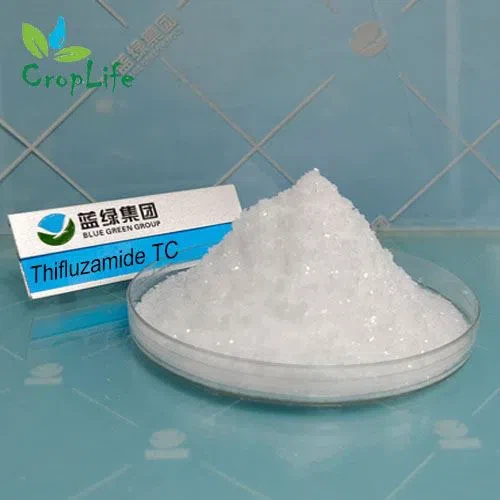
The pure product is a white powdery solid, the melting point is 178°C, the density is 1.930, and the storage condition is 0-6°C. m.p.177.9~178.6℃, the solubility in water is 1.6mg/L at 20℃, the partition coefficient is 4.1, and the pH value is stable at 5~9
mechanism of action
Thifluzamide is a succinate dehydrogenase inhibitor that inhibits succinate dehydrogenase in the tricarboxylic acid cycle of pathogens, resulting in bacterial cell death. It has strong systemic conductivity and can be applied by foliar spray, seed treatment, soil treatment, etc.
What diseases can Thifluzamide prevent?
Thifluzamide has a good control effect on many kinds of fungal diseases, and can be widely used in rice, wheat, peanut, cotton, sugar beet, coffee, potato, lawn and other crops. In production, it is mainly used to control sheath blight of rice and wheat.
Thifluzamide is suitable for various application methods such as foliar spray, seed treatment and soil treatment. Foliar spray is often used to control sheath blight. Booting stage and before is the key period for the prevention and control of sheath blight. Generally, 20-25 ml of 240 g/L suspending agent is used per 667 square meters, and 30-45 liters of water is sprayed. The spraying should be uniform and thoughtful.
For the control of rice sheath blight, due to its long lasting effect, it only needs to be applied once in the whole growth period of rice, that is, 30 days before rice heading, 15-25 ml of 24% suspending agent per mu, 50% of water to water ~ 60 kg spray.
Thifluzamide is active against pathogenic fungi such as Rhizoctonia, Pseudomonas, Stilbene, Aphthora, Phosphorus, Sclerotinia, etc., especially for diseases caused by Basidiomycetes such as Sheath blight, blight, etc.
How should thifluzamide be used?
1. In the years of moderate occurrence of rice sheath blight, in the initial stage of the disease, use 20-30 ml of 240 g/liter thifuramide suspension agent, add 30 to 45 kg of water for foliar spray; when the disease is serious, it is the end of tillering Apply 20-30 ml/mu of thifuramide once in the early stage of booting and booting.
2. To control cotton blight, 240 g/L Thifluzamide suspension agent is used for seed dressing, and the dosage is 0.3-0.5% of the seed mass.
3. To prevent and control peanut white silkworm, leaf spot and rust disease, before or in the early stage of the disease, use 30-40 ml of 240 g/L thifuramide suspension agent to spray and irrigate the pier once, and then apply again after 10-15 days. once.
4. Prevention and control of grape white rot and anthracnose In the early stage of the disease, 240 g/L thifuramide diluted 1500 times and sprayed once every 10-15 days, 2-3 times in a row.
5. Prevent and control sheath blight, root rot, rust, smut of wheat, early blight, anthracnose, rust, root rot, base rot, etc. Anthracnose, rust, bud rot of strawberry, brown spot of lawn, mushroom circle, etc.
Precautions for Thifluzamide
1.It has good systemic properties, it is easy to absorb through the roots or the surface of the plant and conduct it in the plant;
2. The treated stems and leaves are healthy and dark green, providing conditions for increasing production;
3. It does not contain organic solvents, which is very safe for crops, and can also be used in rice booting and flowering period under appropriate dosage;
4. It has strong rain resistance, and the rain does not affect the efficacy of the medicine 1 hour after application