Algae are lower photosynthetic trophic plants that grow in the ocean and are the original producers of marine organic matter. Since seaweed grows in the special environmental medium of seawater, in addition to the nutrients possessed by land plants, it also contains many trace elements such as iodine, potassium, magnesium, manganese, titanium and seaweed polysaccharides that are incomparable to land plants mannitol, etc.
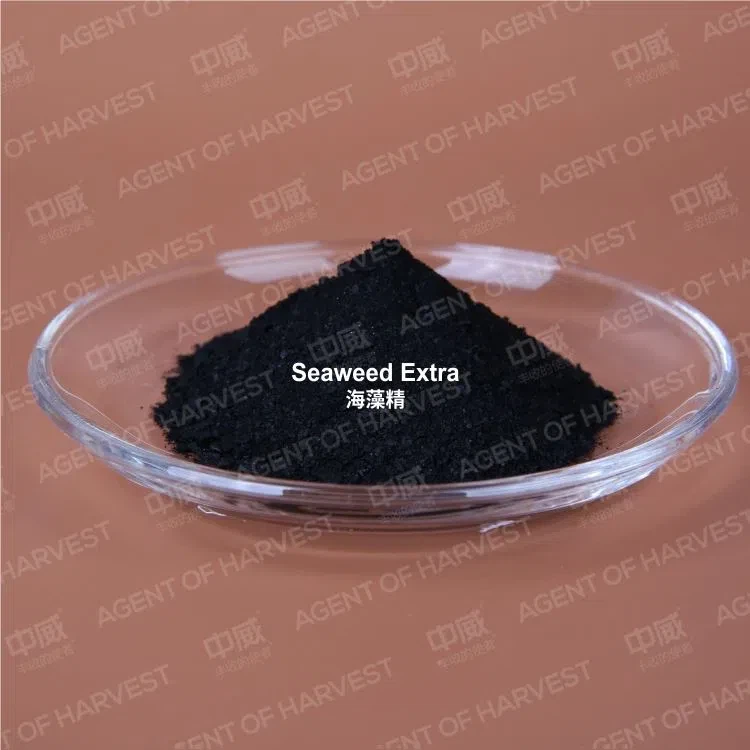
What is seaweed fertilizer?
Seaweed fertilizer refers to the use of macroalgae growing in the ocean as raw materials, through chemical, physical or biological methods, to extract the active ingredients in seaweed, make fertilizer, and apply it to plants as nutrients, which can promote plant growth and improve yield and improve the quality of agricultural products.
There are various forms of seaweed fertilizers. The market is mainly liquid and powder, and a small part is in granular state.
Common names are: seaweed extract, green algae liquid
CAS: 69235-69-4, CAS: 68917-51-1
MF: (C6H8O6)n, EIN ECS Number: 250-715-9
The efficacy and role of seaweed fertilizer
Relevant studies have shown that seaweed has more than 66 active ingredients and active substances, which can provide vegetables with various nutrients, various amino acids, polysaccharides, vitamins, and cytokines. It can help vegetables to establish a strong root system, improve their absorption and utilization of soil nutrients, water and gas, and at the same time can increase the vascular bundle cells of stems, speed up the transportation of water, nutrients and photosynthetic organic products;
Cell division, delay cell senescence, and effectively improve photosynthetic efficiency. In order to achieve the improvement of yield and quality; the improvement of cold resistance, drought resistance and disease resistance. In addition, alginic acid also has the effect of breaking soil compaction and delaying salinization.
In recent years, new fertilizers containing alginic acid have emerged one after another. Alginic acid has long been used in agriculture. Seaweeds used as fertilizers are generally large economical algae, such as macroalgae, Ascophyllum nodosum, and sea cysts. The development of seaweed fertilizer has gone through three stages: rotten seaweed → seaweed ash (powder) → seaweed extract. The core substance in seaweed fertilizer is seaweed extract.
The main raw material is selected from natural seaweed. After special biochemical process, the essence of seaweed is extracted, which greatly retains natural active components, and contains a large amount of non-nitrogenous organic matter, land plant's Unmatched potassium, calcium, magnesium, zinc, iodine and more than forty kinds of mineral elements and rich vitamins, especially containing seaweed polysaccharides, alginic acid , highly unsaturated fatty acids and a variety of natural plant growth regulators It has high biological activity and can stimulate the production of non-specific active factors in plants and regulate the balance of endogenous hormones
After special treatment, the active components in the seaweed are in an active state that is easily absorbed by plants. They enter the plant body 2-3 hours after use, and have a fast absorption and conduction speed. Seaweed contains natural plant growth regulators such as: auxin, cytokinin and gibberellin, etc., which have high biological activity, and the ratio of various substances is similar to that of various hormones of terrestrial plants.
Alginic acid can reduce the surface tension of water, form a film on the surface of plants, increase the contact area, and make it easier for water-soluble substances to penetrate the cell membrane on the surface of stems and leaves and enter plant cells, so that plants can effectively absorb the nutrients in the seaweed extract Therefore, if seaweed liquid fertilizer is used in combination with pesticides, fungicides and chemical fertilizers, the effect is better, the spraying cost can be reduced, and it has a synergistic effect on pesticides and chemical fertilizers. Foreign reports that alginic acid contains natural antiviral effects.
The raw material of seaweed fertilizer is selected from natural seaweed, which has good affinity with terrestrial plants, is harmless to humans and animals, and has no pollution to the environment. It has advantages unmatched by any other fertilizer.
Alginic acid can directly increase organic matter in soil or through plants, activate various beneficial microorganisms in soil, and act as a catalyst in the cycle of plant and microbial metabolites, increasing the biological effectiveness of soil. Metabolites of soil microorganisms can provide more nutrients for plants.
Alginic acid is a natural biological agent that works harmoniously with plant and soil ecosystems. The natural compounds it contains, such as sodium alginate, are natural soil conditioners, which can promote the formation of soil aggregate structure, improve the pore space inside the soil, coordinate the proportions of solid, liquid and gas in the soil, and restore the soil due to overburden and chemical The natural colloid balance lost by pollution increases soil biological activity, promotes the release of nutrients, is conducive to root growth, and improves the stress resistance of crops.
Five characteristics of seaweed fertilizer:
1. Seaweed fertilizer is more nutritious than traditional fertilizers, crops grow evenly after application, and the effect of increasing yield is remarkable, and there is very little deficiency of nutrients.
The seaweed fertilizer uses natural seaweed as the main raw material, and contains numerous natural biologically active substances extracted from seaweed that are beneficial to plant growth and development and the mineral nutrients absorbed by seaweed from the ocean and enriched in the body, including seaweed polysaccharides, phenolic polysaccharides, etc. polymer compound,
Mannitol, betaine, plant growth regulators (cytokinin, gibberellin, auxin and abscisic acid, etc.) and trace elements such as nitrogen, phosphorus, potassium, iron, boron, molybdenum, and iodine. In addition, in order to increase the fertilizer efficiency and the chelation effect of fertilizers, some products are also dissolved in an appropriate amount of humic acid and an appropriate amount of trace elements, which can meet the nutritional needs of crops at various stages of growth.
2. Seaweed fertilizer contains a lot of anti-disease factors and special ingredients, and the fertilizer and medicine have double effects. The stress and disease resistance of crops are significantly enhanced after application, and the effect of pesticides can be improved by foliar spraying.
The seaweed polysaccharides and oligosaccharides, mannitol, phenolic polymer compounds, betaine, alginic acid and natural substances contained in seaweed fertilizer have significant antibacterial, antiviral, and insect repellent effects, and really play the role of fertilizers. It greatly enhances the cold resistance, drought resistance, disease resistance, lodging resistance, and salinity resistance of crops, and produces strong resistance to blight, virus disease, anthracnose, downy mildew, gray mold, powdery mildew, and fusarium wilt.
In addition, alginic acid in seaweed fertilizer can reduce the surface tension of water, form a film on the surface of plants, increase the contact area, and make it easier for water-soluble substances to penetrate the cell membrane on the surface of stems and leaves and enter plant cells, so that plants can effectively absorb seaweed Nutrients in the extract.
If seaweed fertilizer is used in combination with pesticides and fungicides, it has a synergistic effect and can reduce spraying costs.
3. Seaweed fertilizer contains a lot of highly active ingredients, which are easily absorbed by plants. The crops grow vigorously after application, which can obviously improve the yield and the quality of crops.
Seaweed polysaccharides, alginic acid, highly unsaturated fatty acids and other substances unique to seaweed have high biological activity and can stimulate the production of non-specific active factors in plants.
At the same time, seaweed fertilizer also contains natural plant growth regulators, such as: auxin, cytokinin and gibberellin, etc., the proportion of which is similar to the proportion of hormones in terrestrial plants, and has a good ability to regulate the balance of endogenous hormones effect.
After the crops are applied, the yield and quality are obviously improved, the yield of leafy vegetables is increased by more than 20%, the yield of grain crops is increased by more than 15%, and the yield of fruit trees is increased by 10% to 30%. , cotton, flowers and other economic crops, especially for greenhouse vegetable crops, the effect of increasing production and value-added is very significant.
4. Seaweed fertilizer is rich in organic matter and slow-release factors, and has a long fertilizer effect, which can improve soil microecology, promote root growth and resist repeated cropping.